Lab note · September 4, 2026
Sandbox of Elements Element and Reaction Database
A current, source-checked guide to sandbox of elements element and reaction database, with practical steps, failure fixes, and clear evidence limits.
Use this as a verified partial index: identify an element by its current category and visible label, then keep recipes and unlock conditions separate until they are reproduced.

Quick answer and operating boundary
Use this as a verified partial index: identify an element by its current category and visible label, then keep recipes and unlock conditions separate until they are reproduced. This is the direct answer for Sandbox of Elements Element and Reaction Database, checked against the sources and observations available on September 4, 2026.
Scope boundary: The roster is intentionally partial; category membership is current-session evidence, while complete recipes and permanent unlock rules remain unverified. The page distinguishes verified facts, a single current observation, an actionable hypothesis, and an unknown field. Those states stay visible because a useful answer is more trustworthy when it says exactly where evidence ends.
What is verified now
Verified point 1 for Sandbox of Elements Element and Reaction Database: The current web build visibly groups elements into fourteen categories, from Basic through Machines. This point is kept separate from neighboring assumptions so a visible label, an official feature description, or a dated patch statement does not silently authorize an unstated number or universal strategy. Use it as the fixed baseline for the next decision, and recheck the cited source when the live interface differs.
Verified point 2 for Sandbox of Elements Element and Reaction Database: The official Poki page says more than ninety elements can be unlocked. This point is kept separate from neighboring assumptions so a visible label, an official feature description, or a dated patch statement does not silently authorize an unstated number or universal strategy. Use it as the fixed baseline for the next decision, and recheck the cited source when the live interface differs.
Verified point 3 for Sandbox of Elements Element and Reaction Database: Basic currently shows Sand, Water, Stone, Wood, Soil, Glass, Cloud, and Mud. This point is kept separate from neighboring assumptions so a visible label, an official feature description, or a dated patch statement does not silently authorize an unstated number or universal strategy. Use it as the fixed baseline for the next decision, and recheck the cited source when the live interface differs.
Verified point 4 for Sandbox of Elements Element and Reaction Database: Machines currently shows Glue, Bouncy, two conveyor directions, Heater, and Cooler. This point is kept separate from neighboring assumptions so a visible label, an official feature description, or a dated patch statement does not silently authorize an unstated number or universal strategy. Use it as the fixed baseline for the next decision, and recheck the cited source when the live interface differs.
Step-by-step route
Step 1 — Choose the category shown in the live toolbar. For Sandbox of Elements Element and Reaction Database, record the screen or state before acting, make only this bounded change, and note the first visible result. Keep any currency, inventory, formation, map, element, or mission value that was not displayed out of the claim. If the expected checkpoint is missing, stop here rather than carrying an uncertain premise into the next step.
Step 2 — Copy the element label exactly as displayed. For Sandbox of Elements Element and Reaction Database, record the screen or state before acting, make only this bounded change, and note the first visible result. Keep any currency, inventory, formation, map, element, or mission value that was not displayed out of the claim. If the expected checkpoint is missing, stop here rather than carrying an uncertain premise into the next step.
Step 3 — Record whether the tile is immediately usable or carries a visible overlay. For Sandbox of Elements Element and Reaction Database, record the screen or state before acting, make only this bounded change, and note the first visible result. Keep any currency, inventory, formation, map, element, or mission value that was not displayed out of the claim. If the expected checkpoint is missing, stop here rather than carrying an uncertain premise into the next step.
Step 4 — Link a reaction only after its inputs and output have been reproduced. For Sandbox of Elements Element and Reaction Database, record the screen or state before acting, make only this bounded change, and note the first visible result. Keep any currency, inventory, formation, map, element, or mission value that was not displayed out of the claim. If the expected checkpoint is missing, stop here rather than carrying an uncertain premise into the next step.
Decision table in practice
Decision row 1 for Sandbox of Elements Element and Reaction Database starts with the current state that makes this action relevant: Choose the category shown in the live toolbar. The available choice must be visible in the current client or stated by a cited first-party source. The expected benefit is a testable hypothesis until the result appears. The stop condition is reached when the named bottleneck does not move after one clean comparison or when a new prerequisite becomes visible.
Decision row 2 for Sandbox of Elements Element and Reaction Database starts with the current state that makes this action relevant: Copy the element label exactly as displayed. The available choice must be visible in the current client or stated by a cited first-party source. The expected benefit is a testable hypothesis until the result appears. The stop condition is reached when the named bottleneck does not move after one clean comparison or when a new prerequisite becomes visible.
Decision row 3 for Sandbox of Elements Element and Reaction Database starts with the current state that makes this action relevant: Record whether the tile is immediately usable or carries a visible overlay. The available choice must be visible in the current client or stated by a cited first-party source. The expected benefit is a testable hypothesis until the result appears. The stop condition is reached when the named bottleneck does not move after one clean comparison or when a new prerequisite becomes visible.
Decision row 4 for Sandbox of Elements Element and Reaction Database starts with the current state that makes this action relevant: Link a reaction only after its inputs and output have been reproduced. The available choice must be visible in the current client or stated by a cited first-party source. The expected benefit is a testable hypothesis until the result appears. The stop condition is reached when the named bottleneck does not move after one clean comparison or when a new prerequisite becomes visible.
Failure symptoms and recovery
Failure pattern 1: A copied list may belong to another build. Diagnose this possibility before spending more or publishing a correction. Recreate the smallest relevant setup, compare it with the saved baseline, and change one condition. A single mismatch makes the current route partial; it does not prove that every platform, account stage, opponent, geometry, or later version behaves the same way.
Failure pattern 2: A tile overlay may be mistaken for a permanent recipe lock. Diagnose this possibility before spending more or publishing a correction. Recreate the smallest relevant setup, compare it with the saved baseline, and change one condition. A single mismatch makes the current route partial; it does not prove that every platform, account stage, opponent, geometry, or later version behaves the same way.
Failure pattern 3: An effect may be visible even when the output label is unreadable. Diagnose this possibility before spending more or publishing a correction. Recreate the smallest relevant setup, compare it with the saved baseline, and change one condition. A single mismatch makes the current route partial; it does not prove that every platform, account stage, opponent, geometry, or later version behaves the same way.
Failure pattern 4: Missing rows may be reported as zero instead of unknown. Diagnose this possibility before spending more or publishing a correction. Recreate the smallest relevant setup, compare it with the saved baseline, and change one condition. A single mismatch makes the current route partial; it does not prove that every platform, account stage, opponent, geometry, or later version behaves the same way.
Version, source, and update rules
The public version of Sandbox of Elements Element and Reaction Database is dated September 4, 2026. Recheck it after a patch, interface change, economy change, altered tutorial, or repeated current-player contradiction that touches the named task. Keep the former observation with its date, append the replacement, and state which client, platform, account stage, and screen supplied the new result.
For Sandbox of Elements Element and Reaction Database, first-party documentation establishes identity and explicit mechanics. A current live-client observation can establish what one account displayed. Two independent current observations can strengthen a variable behavior. Search snippets, old videos, and similar game names may open a research task, but they cannot overwrite a verified row without matching the exact game and version.
How to use the page visuals
The official or platform image on Sandbox of Elements Element and Reaction Database is a recognition aid for the correct game and interface family. It does not prove every value, availability rule, or optimal choice shown elsewhere on the page. Compare visual landmarks with the live client before following a position, item, element, map, or menu instruction.
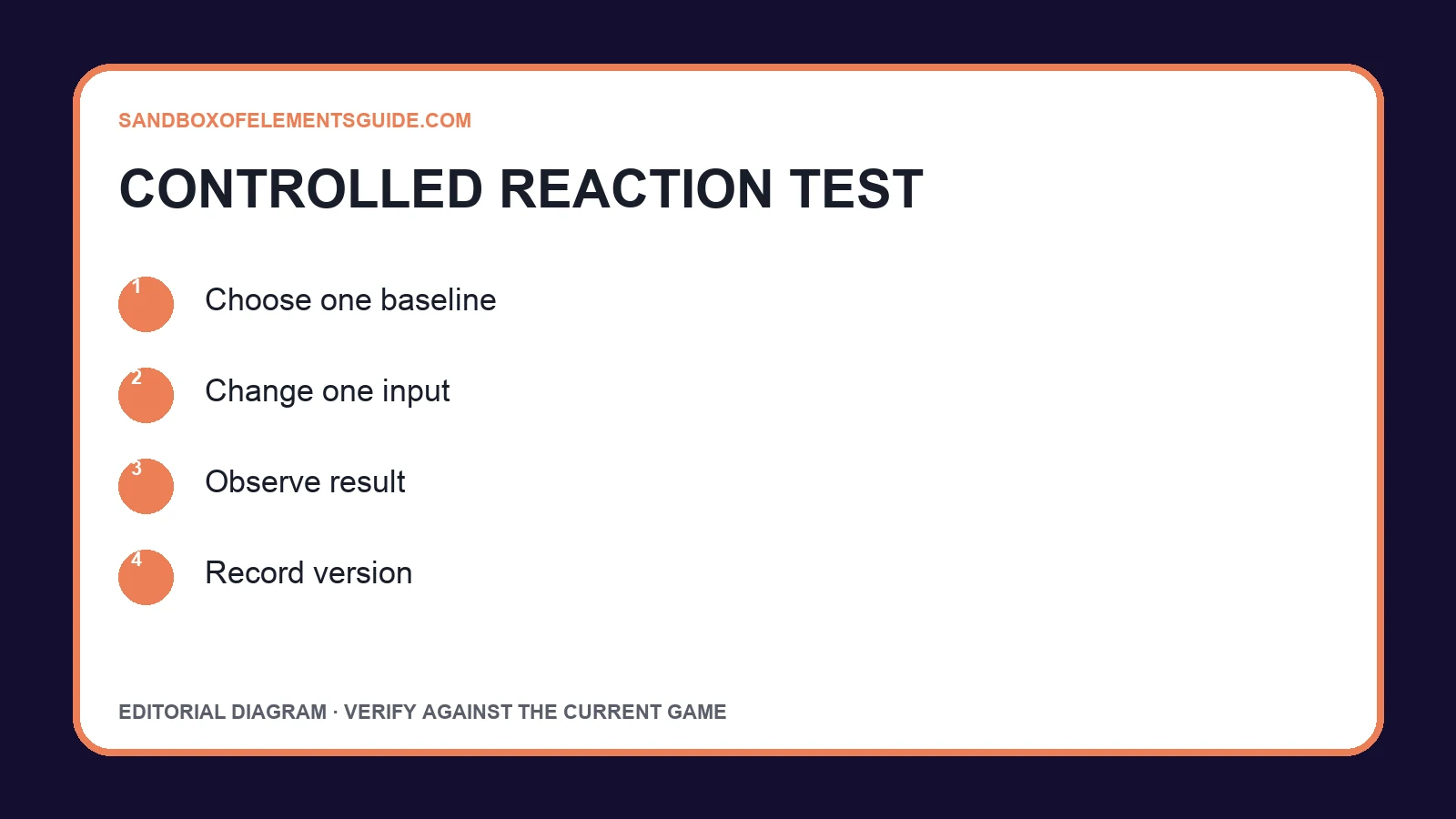
The labelled editorial diagram expresses the decision path behind Sandbox of Elements Element and Reaction Database. It is original explanatory artwork, not a gameplay screenshot. Follow its sequence—baseline, bounded action, visible checkpoint, stop condition, and evidence state—when the live scene differs from the promotional image.
Field notes for Sandbox of Elements Element and Reaction Database
Field note 1 for Sandbox of Elements Element and Reaction Database connects three page-specific signals. Baseline: The current web build visibly groups elements into fourteen categories, from Basic through Machines. Operational move: Choose the category shown in the live toolbar. Confounder to exclude: A copied list may belong to another build. Write those three lines beside the live screen before the test. The result is useful only when the baseline remains identifiable, the operational move is the only intentional change, and the confounder has been checked rather than assumed away.
Field note 2 for Sandbox of Elements Element and Reaction Database connects three page-specific signals. Baseline: The official Poki page says more than ninety elements can be unlocked. Operational move: Copy the element label exactly as displayed. Confounder to exclude: A tile overlay may be mistaken for a permanent recipe lock. Write those three lines beside the live screen before the test. The result is useful only when the baseline remains identifiable, the operational move is the only intentional change, and the confounder has been checked rather than assumed away.
Field note 3 for Sandbox of Elements Element and Reaction Database connects three page-specific signals. Baseline: Basic currently shows Sand, Water, Stone, Wood, Soil, Glass, Cloud, and Mud. Operational move: Record whether the tile is immediately usable or carries a visible overlay. Confounder to exclude: An effect may be visible even when the output label is unreadable. Write those three lines beside the live screen before the test. The result is useful only when the baseline remains identifiable, the operational move is the only intentional change, and the confounder has been checked rather than assumed away.
Field note 4 for Sandbox of Elements Element and Reaction Database connects three page-specific signals. Baseline: Machines currently shows Glue, Bouncy, two conveyor directions, Heater, and Cooler. Operational move: Link a reaction only after its inputs and output have been reproduced. Confounder to exclude: Missing rows may be reported as zero instead of unknown. Write those three lines beside the live screen before the test. The result is useful only when the baseline remains identifiable, the operational move is the only intentional change, and the confounder has been checked rather than assumed away.
Final verification checklist
Before acting on Sandbox of Elements Element and Reaction Database, confirm the exact game, current platform, visible task, prerequisite, available choice, expected checkpoint, recovery path, version date, and evidence state. If one field is missing, collect it first. This checklist prevents an attractive but unsupported shortcut from consuming currency, progress, board space, or a limited test opportunity.
After the result for Sandbox of Elements Element and Reaction Database, save what changed and what did not. If this specific task is complete, stop. If its failure category changed, use that new bottleneck to choose the next guide. If nothing changed after a clean comparison, preserve the evidence and escalate the exact unresolved condition instead of repeating the same broad action.