Lab note · September 4, 2026
Sandbox of Elements Beginner Route and First Unlocks
A reproducible first-session route for Sandbox of Elements, with safe experiments, unlock logging, and recovery steps when a discovery does not trigger.
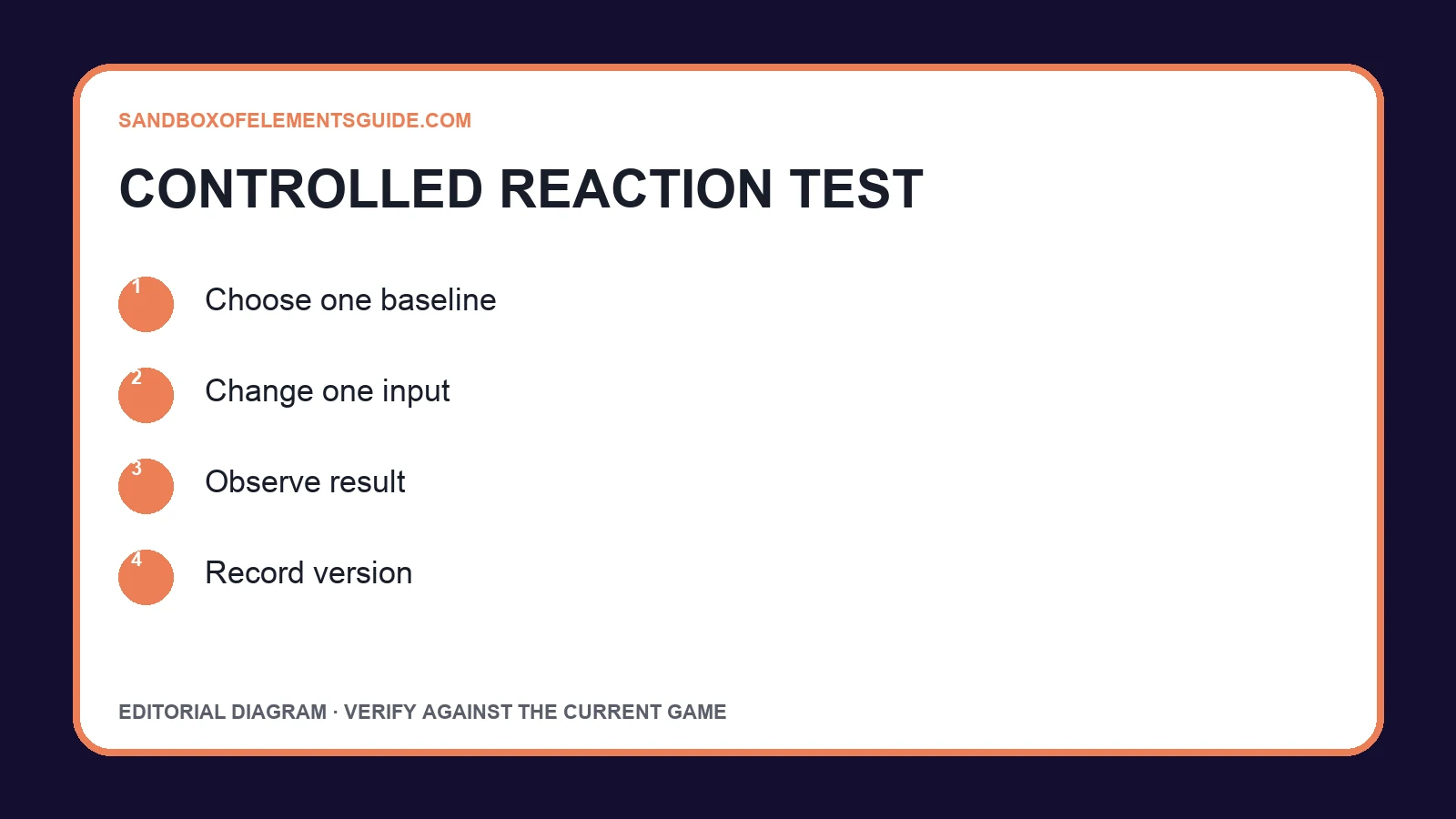
Begin with small, separated samples of visible basic elements. Observe each element alone, then combine one pair at a time and record the result before adding a third variable.

Quick answer and scope
Begin with small, separated samples of visible basic elements. Observe each element alone, then combine one pair at a time and record the result before adding a third variable. This claim is scoped specifically to Sandbox of Elements Beginner Route and First Unlocks.
This page is for one task: solve the player task described by Sandbox of Elements Beginner Route and First Unlocks It applies to the version checked on September 4, 2026. If the current screen differs, stop at the first mismatch and use the troubleshooting section instead of forcing the route. This claim is scoped specifically to Sandbox of Elements Beginner Route and First Unlocks.
What the accepted sources actually prove
The official Poki page identifies Flagwin's game as a simulation with more than 90 unlockable elements. It names physical behaviors for sand, water, fire, lava, and ice, and gives lava plus water producing obsidian as one example reaction. This claim is scoped specifically to Sandbox of Elements Beginner Route and First Unlocks.
That evidence supports the game's identity and the named systems, but it does not make every neighboring value true. The official page does not publish a complete recipe table, exact unlock order, or every hidden condition. Those fields remain partial or unknown until reproduced in the current game. This page keeps that boundary visible so an unknown field cannot silently become a confident recommendation. This claim is scoped specifically to Sandbox of Elements Beginner Route and First Unlocks.
The route map for this task
This page adds a bounded route map, a current-version evidence boundary, and a recovery path for Sandbox of Elements Beginner Route and First Unlocks. It is designed to answer the named task without importing unsupported details from a similar game or an older build. This claim is scoped specifically to Sandbox of Elements Beginner Route and First Unlocks.
Use the route map as a decision aid, not as decoration. Read the required input, choose the next action, note the expected visible output, and keep the fallback beside it. If any required input is unknown, the safe action is to gather that evidence before spending currency or committing progress. This claim is scoped specifically to Sandbox of Elements Beginner Route and First Unlocks.
Run the route without mixing variables
Start by naming the current bottleneck in one sentence. Then follow this bounded answer: Begin with small, separated samples of visible basic elements. Observe each element alone, then combine one pair at a time and record the result before adding a third variable. Change only the element, item, unit position, ship choice, or progression action directly tied to that bottleneck. This claim is scoped specifically to Sandbox of Elements Beginner Route and First Unlocks.
After the action, return to the same screen or encounter and compare the result. A successful outcome without a stable baseline is useful for play but weak as evidence. A failed outcome with a clean baseline is valuable because it tells the next player which assumption not to repeat. This claim is scoped specifically to Sandbox of Elements Beginner Route and First Unlocks.
Decision table
Use four columns: current state, available choice, expected benefit, and stop condition. Current state must come from the live game. Available choice must be visible or explicitly documented. Expected benefit may be a hypothesis, but it must be labelled as one. Stop condition prevents an open-ended upgrade or experiment from consuming resources without solving the original task. This claim is scoped specifically to Sandbox of Elements Beginner Route and First Unlocks.
Verify identity and system boundaries with the cited first-party source, then confirm version-sensitive conditions in the current client or with two independent current sources. A repeatable current observation may be labelled verified. One clean observation is partial. A missing label, result, or repeat remains unknown; none of those states should be converted into zero. This claim is scoped specifically to Sandbox of Elements Beginner Route and First Unlocks.
Build a clean first-session laboratory
Treat the empty board as a controlled workspace, not a canvas to fill. Reserve one area for the element being tested, one for the second input, and one empty strip where they can meet. Small samples make it easier to see whether movement, heat, or direct contact caused a result. If the board becomes crowded, reset before drawing a conclusion; a hidden third material can turn a simple pair into a different experiment.
Before combining anything, place each visible starter element alone and watch how it behaves. Note whether it falls, flows, rises, spreads, burns, cools, or remains fixed. The official description establishes that elements have physical behaviors, so this baseline is part of the answer. It lets a new player predict where contact will occur and prevents a missed reaction from being blamed on a recipe that never actually touched.
Use a low-risk unlock sequence
Start with pairs whose movement makes the contact easy to observe. Draw one input, pause, then introduce the second at a single boundary. Keep the rest of the board empty. The goal is not to guess a long secret chain; it is to produce one readable result and learn how the game signals discovery. In our September 4 browser check, water and lava produced a visible Steam discovery notice, which confirms that a successful reaction can create and announce a new element in the current web build.
After a discovery, test the new element alone before using it as an ingredient. Record its label exactly as the interface displays it, the two inputs, their placement, the direction of contact, the visible output, and whether an unlock notice appeared. That record becomes the prerequisite for a later recipe page. A visually interesting effect without a readable label remains an observation, not a database row.
Recover when the expected discovery does not appear
A failed attempt has four common explanations: the materials never contacted, too much of one input destroyed the other, an existing material contaminated the boundary, or the current build uses another condition. Clear the area and repeat at a smaller scale before changing ingredients. If the result still differs, reverse the placement order and record both attempts separately; do not silently merge them into one claim.
Stop after two clean attempts with the same setup. Continuing to redraw the same pair on a contaminated board does not increase confidence. Mark the combination unverified for this session and move to another visible pair. This stop rule protects the player from wasting time and protects the site from publishing a guessed unlock sequence as fact.
Turn discoveries into a progression route
A useful route is a dependency map: visible starter, verified pair, newly unlocked element, and the next test that genuinely requires it. It is not a numbered list copied from an older build. Promote a discovery into the route only after the label and result are reproducible. Keep optional experiments on side branches so a player can reach the next required tool without performing every decorative reaction.
When a patch adds categories or changes the discovery screen, preserve the old observation with its date and begin a new branch. The first-session page should remain short enough to follow while playing, while the separate reactions explainer handles experimental method. This division gives beginners a next action without pretending that the whole 90-plus-element space has already been mapped.
Final verification checklist
Confirm the exact game, platform, current version, task, prerequisite, chosen action, expected visible result, recovery option, and evidence state. If all nine are clear, execute the smallest useful action. If one is missing, collect it before committing a scarce resource. This claim is scoped specifically to Sandbox of Elements Beginner Route and First Unlocks.
The short rule remains: Begin with small, separated samples of visible basic elements. Observe each element alone, then combine one pair at a time and record the result before adding a third variable. Verify the visible result, save the date, and leave unsupported precision unknown. This claim is scoped specifically to Sandbox of Elements Beginner Route and First Unlocks.