Lab note · September 4, 2026
How Reactions Work in Sandbox of Elements
Learn how contact, amount, placement, and repeat tests affect Sandbox of Elements reactions without relying on an unverified recipe list.
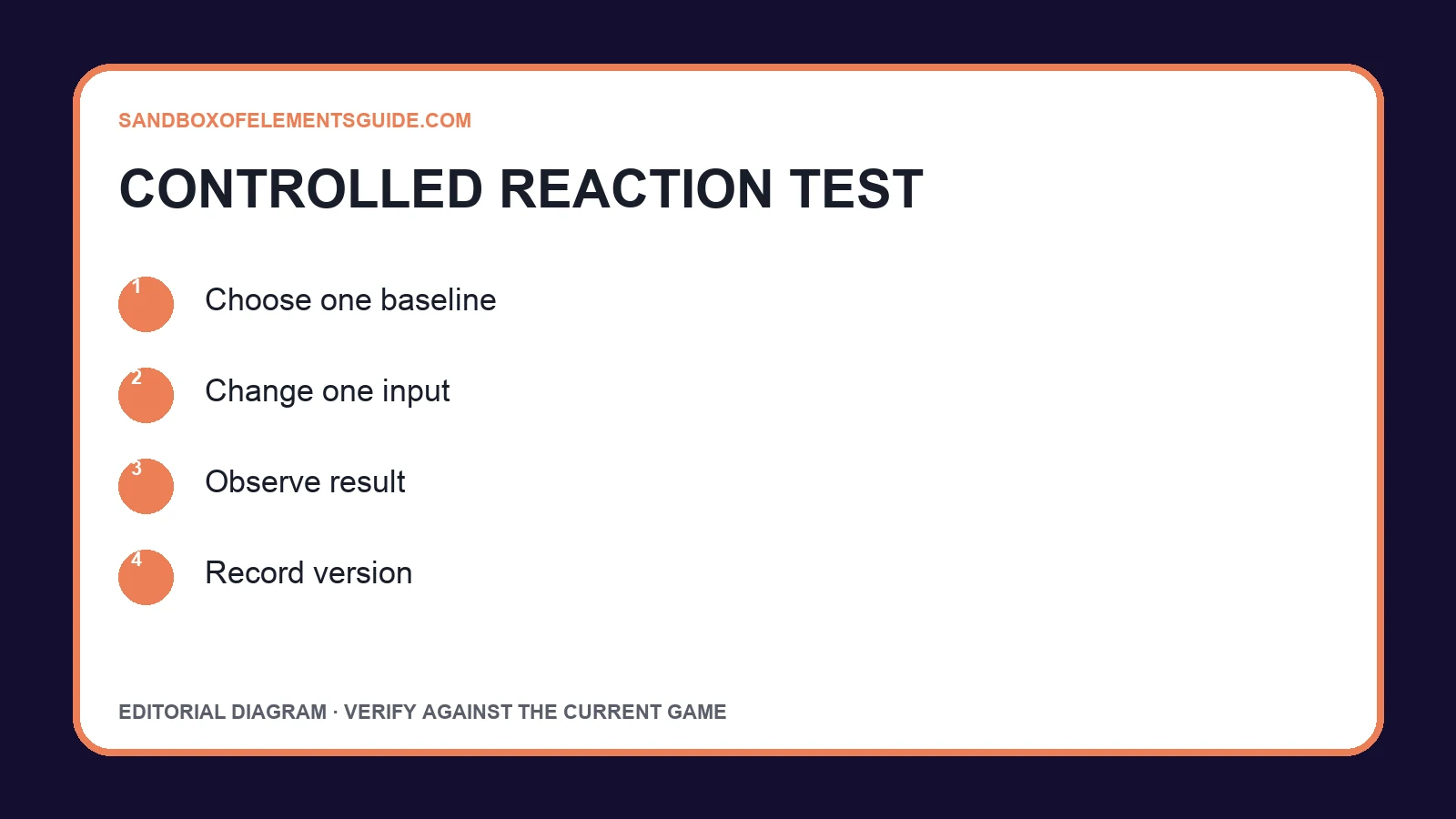
Treat every reaction as an input, contact condition, observed output, and version. A reaction is verified only when the same setup produces the same visible result again.

Quick answer and scope
Treat every reaction as an input, contact condition, observed output, and version. A reaction is verified only when the same setup produces the same visible result again. This claim is scoped specifically to How Reactions Work in Sandbox of Elements.
This page is for one task: solve the player task described by How Reactions Work in Sandbox of Elements It applies to the version checked on September 4, 2026. If the current screen differs, stop at the first mismatch and use the troubleshooting section instead of forcing the route. This claim is scoped specifically to How Reactions Work in Sandbox of Elements.
What the accepted sources actually prove
The official Poki page identifies Flagwin's game as a simulation with more than 90 unlockable elements. It names physical behaviors for sand, water, fire, lava, and ice, and gives lava plus water producing obsidian as one example reaction. This claim is scoped specifically to How Reactions Work in Sandbox of Elements.
That evidence supports the game's identity and the named systems, but it does not make every neighboring value true. The official page does not publish a complete recipe table, exact unlock order, or every hidden condition. Those fields remain partial or unknown until reproduced in the current game. This page keeps that boundary visible so an unknown field cannot silently become a confident recommendation. This claim is scoped specifically to How Reactions Work in Sandbox of Elements.
The verification checklist for this task
This page adds a bounded verification checklist, a current-version evidence boundary, and a recovery path for How Reactions Work in Sandbox of Elements. It is designed to answer the named task without importing unsupported details from a similar game or an older build. This claim is scoped specifically to How Reactions Work in Sandbox of Elements.
Use the verification checklist as a decision aid, not as decoration. Read the required input, choose the next action, note the expected visible output, and keep the fallback beside it. If any required input is unknown, the safe action is to gather that evidence before spending currency or committing progress. This claim is scoped specifically to How Reactions Work in Sandbox of Elements.
Run the route without mixing variables
Start by naming the current bottleneck in one sentence. Then follow this bounded answer: Treat every reaction as an input, contact condition, observed output, and version. A reaction is verified only when the same setup produces the same visible result again. Change only the element, item, unit position, ship choice, or progression action directly tied to that bottleneck. This claim is scoped specifically to How Reactions Work in Sandbox of Elements.
After the action, return to the same screen or encounter and compare the result. A successful outcome without a stable baseline is useful for play but weak as evidence. A failed outcome with a clean baseline is valuable because it tells the next player which assumption not to repeat. This claim is scoped specifically to How Reactions Work in Sandbox of Elements.
Decision table
Use four columns: current state, available choice, expected benefit, and stop condition. Current state must come from the live game. Available choice must be visible or explicitly documented. Expected benefit may be a hypothesis, but it must be labelled as one. Stop condition prevents an open-ended upgrade or experiment from consuming resources without solving the original task. This claim is scoped specifically to How Reactions Work in Sandbox of Elements.
Verify identity and system boundaries with the cited first-party source, then confirm version-sensitive conditions in the current client or with two independent current sources. A repeatable current observation may be labelled verified. One clean observation is partial. A missing label, result, or repeat remains unknown; none of those states should be converted into zero. This claim is scoped specifically to How Reactions Work in Sandbox of Elements.
Describe a reaction as a testable claim
Write every claim in the same five-part form: input A, input B, contact method, visible result, and discovery state. For example, the official page gives lava plus water producing obsidian as an illustrative reaction, while our live web observation showed a Steam discovery notification from a water-and-lava contact. Those are related but not interchangeable outputs, so each belongs in its own dated record until the exact conditions are reproduced.
Quantity is part of the setup even when the interface does not display a number. A thin line, a small pool, and a board-sized mass can create different contact duration and heat behavior. Use plain relative labels such as trace, small, and large rather than inventing measurements. Add a sketch or screenshot of placement when shape appears important.
Separate contact, order, and environment
Direct contact means the two materials visibly touch. Indirect contact means heat, movement, or another effect crosses the gap. Test these separately. First place A and add B; then clear the board, place B, and add A. A quick reverse-order check that produces no new discovery does not prove the reaction is impossible, but it is a useful partial observation that points to order, geometry, or an already-unlocked output.
The environment includes every material already on the board and the space available for movement. Sand falling into water is a different setup from water poured over packed sand. Fire beside a barrier is not equivalent to fire inside a closed pocket. When a guide omits this context, players may follow the named ingredients correctly and still fail because the original author never documented the physical arrangement.
Assign evidence states consistently
Use verified only when the same current-build setup produces the same labelled result again. Use partial when there is one clean observation, an official example without full conditions, or two sources that disagree on a detail. Use unknown when the label, prerequisite, or output cannot be read. Use disproven only for the precise tested setup, not for every possible arrangement of the same ingredients.
These labels matter more than a large recipe count. A database with forty verified rows and clear reproduction notes is more useful than one with ninety copied names and no version boundary. When an old row changes, append the new observation and mark which build it applies to instead of overwriting the history; that makes disagreements diagnosable.
Design the next experiment from the failure
If nothing happens, the next test should alter only one variable: contact direction, quantity, enclosure, or an additional verified catalyst. If the materials disappear, reduce the more destructive input. If a familiar product appears but no discovery notice shows, check whether it was already unlocked. If multiple products appear, simplify the geometry until the primary boundary is visible.
End the session with a queue of specific tests rather than a vague hunt for secrets. Each queue item should name the missing evidence and the one variable to change. That workflow turns play into a repeatable research process and gives future articles something more valuable than speculation: conditions another player can follow and challenge.
Final verification checklist
Confirm the exact game, platform, current version, task, prerequisite, chosen action, expected visible result, recovery option, and evidence state. If all nine are clear, execute the smallest useful action. If one is missing, collect it before committing a scarce resource. This claim is scoped specifically to How Reactions Work in Sandbox of Elements.
The short rule remains: Treat every reaction as an input, contact condition, observed output, and version. A reaction is verified only when the same setup produces the same visible result again. Verify the visible result, save the date, and leave unsupported precision unknown. This claim is scoped specifically to How Reactions Work in Sandbox of Elements.